Find the panel first
Before the front, before the badges, before the reviews. If a listing carries no photograph of one, ask the seller before you buy.
Everything on the front of a bottle was chosen by a marketing department. One panel on the back was not, and on this product it does not exist.
Written by the Breathizen editorial team·Last updated October 11, 2026·How this page was checked
A Supplement Facts panel is the part of a supplement label written to somebody else's format. Under 21 CFR 101.36 it carries the serving size, the servings per container, the name and the amount per serving of every dietary ingredient, a percent Daily Value where one exists, and an other-ingredients line. Breathizen has none: no panel was supplied to this desk in any form and none appears in any artwork. Five ingredients are named, not one carries an amount, and the only number printed beside any of them is 10:1 on the mullein, a ratio rather than a dose. That does not mean the amounts are low. It means nobody outside the company knows them.

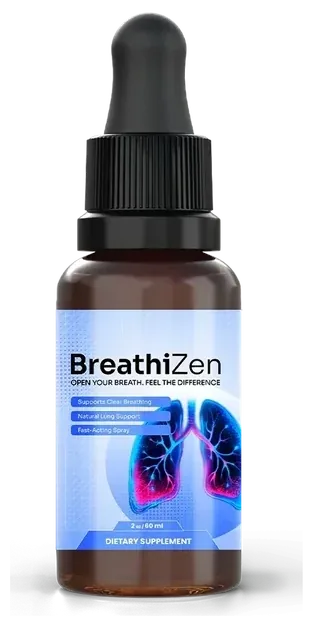
The first half is the front: a wordmark, an illustration, a strapline and two or three phrases about what the product supports. Every element of it was chosen by somebody whose job is to sell the bottle. That is not a criticism — it is what packaging is for — but it makes the front an argument rather than a record.
The second half is the Supplement Facts panel. Its content, its order, its units and in places its typography are set by federal regulation. The company decides what goes in the bottle; the panel decides how it must be described.
That is why the panel is worth more than the rest of the pack put together: it is the only part written to a format the seller did not choose. The graphic above is the brand's How Breathizen Works explainer, and its tile labelled SUPPLEMENT FACTS is a generic document icon — the only place those words appear in this pack.
21 CFR 101.36, in ordinary English.
| Line | What it does for a reader |
|---|---|
| Serving size | Converts a container into a supply. Without it, a volume on the front is a quantity of liquid rather than a number of days. |
| Servings per container | Follows from the first, and is what gives you a cost per day rather than a cost per bottle. |
| Each dietary ingredient, by name | Says what is in it, in a fixed order, under recognised names. |
| The amount per serving | The most useful number on any supplement: what lets an ingredient be set beside the dose a study used. |
| Percent Daily Value | For ingredients that have one. The only figure a reader can recheck without leaving the label. |
| A footnote | For ingredients with no established Daily Value, marked with a dagger. Most botanicals sit there. |
| Other ingredients | Everything present that is not a dietary ingredient: on a liquid, the carrier, the preservative, any sweetener. |
Seven lines, answering how many, how long, what, how much and what else. Breathizen publishes a serving size and nothing else on that list.
Breathizen is a 2 oz / 60 mL liquid, taken as four pumps — 0.60 mL — once a day. It names five ingredients: mullein leaf, ginger root, bromelain, lemon and cordyceps. No Supplement Facts panel was supplied with it in any form, so not one of those five carries a printed amount. What can be checked is the arithmetic: 60 mL at 0.60 mL a day is a hundred days a bottle, not thirty.
60-day money-back window · from $0.49 a day · 100 days a bottle · ships from the USTurn the bottle round and count two things: how many ingredients carry a weight, and how many do not. That one fraction says more about a product's disclosure than any amount of front-panel copy.
Then look at the serving size and divide: a 60 mL bottle at 0.60 mL a day is a hundred days, and at 2 mL a day it is thirty. Then look for standardisation on anything called an extract, because a stated proportion of a marker compound is what turns milligrams into a comparable dose.
Run that on this product and it stops at the first step. The fraction is 0 of 5. There is no amount to divide, no standardisation to look for and no other-ingredients line to read, because there is no panel to print any of them on.
Ingredients with a printed amount against ingredients without. Seventeen and zero has told you everything. Five and zero has told you nothing.
A proprietary blend is the usual way a panel gives less than it appears to give. Under 21 CFR 101.36(c) a blend declares the total weight of its dietary ingredients and lists them in descending order of predominance by weight; individual amounts are not required.
It is the thing this desk normally complains about, and on this product it is the thing we would upgrade to. A blend prints a combined weight and an order, and descending order is a mathematical statement: the ingredient in position n cannot exceed the total divided by n. That hands you a ceiling for every position — not an amount, but arithmetic.
Breathizen prints no total and no order. Five names, in whatever sequence the designer chose, with nothing to divide. There is no ceiling to compute, which is why the dose comparison that runs on every other product this desk reads cannot be run here.

Here is the worked example. Breathizen names five dietary ingredients: Mullein Leaf Extract 10:1, Ginger Root Extract, Bromelain Powder, Organic Lemon Extract and Organic Cordyceps militaris Fruit Extract. Not one carries an amount. No panel was supplied in any form, and no photograph of the back or base of the bottle either.
One number is printed beside an ingredient, and it is the one most likely to be misread as a strength. 10:1 on the mullein is a concentration ratio, not a dose — ten parts of leaf reduced to one part of extract. A 10:1 extract at 5 mg and one at 500 mg are the same ratio and completely different products.
Then be exact about what the absence means, because the easy reading is the wrong one. It does not mean the amounts are low. They may well be generous. It means nobody outside the company knows what they are — not a pharmacist, not a clinician, not this desk and not you. An unweighed ingredient is not a small one. It is an unknown one.
This desk holds no test result and no certificate of analysis. Reference B-1164-26-BR is a string of the right shape and nothing more. We are not saying the bottle is weak; we are saying the label will not let anybody find out.
Before the front, before the badges, before the reviews. If a listing carries no photograph of one, ask the seller before you buy.
Ingredients with a printed amount against ingredients without. Here the answer is 0 of 5, which tells you more than the whole front panel.
A ratio, a proportion of a marker compound and a milligram figure are three different things. Only the third is an amount.
Everything in this post is about what a panel discloses, not whether the disclosure is accurate. A perfectly compliant panel can carry amounts nobody has tested. A panel is a floor rather than a verdict — which is why a product with none cannot be assessed, rather than merely assessed badly.
The Dietary Supplement Health and Education Act of 1994 created the modern category. Before it, the boundary between a food, a supplement and a drug was contested in a way that gave shoppers very little clarity.
The bargain it struck was straightforward. Supplements would not need pre-market approval of their formulas or their claims — a substantial liberty. In exchange they would have to disclose what they contained, in a standard format, on the pack.
The panel is the disclosure half of that bargain, which is why a product without one is not simply badly labelled. It is taking the liberty without the disclosure meant to come with it.
It is worth being even-handed, because a panel guarantees nothing. It does not tell you whether the printed amounts are present; that requires testing, and no test result was supplied here. Nor whether an ingredient works at that amount; that is what the research is for.
It does not tell you whether an extract is standardised unless the label says so, and it does not tell you who made the product unless a distributor line names a manufacturer. That is not required, and here it does not happen: no manufacturer and no distributor is named anywhere in anything supplied to this desk.
So a panel is necessary and not sufficient — the floor below which a product cannot be assessed at all, which is why its absence is the most serious thing this desk has found on any label.

The desk reads the label at native resolution, recomputes every figure on it, and opens every source it cites. On this product there was no panel to read, so what this site publishes instead is a complete and specific account of what is missing. It earns a commission on orders placed through this site, which is why that account is at the top of the page rather than the bottom.
These slots are vacant on purpose. A physician's name was supplied with the product pack and we were asked to print it as the medical reviewer of these pages. He has not read them — they were written after the pack arrived — so printing his name would assert a professional endorsement that has not happened. On a product sold to people with breathing problems, that matters more than usual.
Sources are listed in full on every page that makes a claim · Our method and who writes this · Report a correction
Written and fact-checked by The Breathizenres Editorial Desk, last updated October 11, 2026. A highlighted slot means that value has not been supplied yet and nothing has been invented in its place — why the reviewer line is empty.